Blog · Ecommerce copy · 9 min read
You started an online business from home: here's why your product descriptions could get you in trouble
If you sell candles, skincare, clothing or homewares online, words like natural, eco-friendly and sustainable can feel harmless. Here's what Australian home businesses should know before publishing them.
By Sprout Check Editorial · Published 17 July 2026 · Last reviewed 17 July 2026
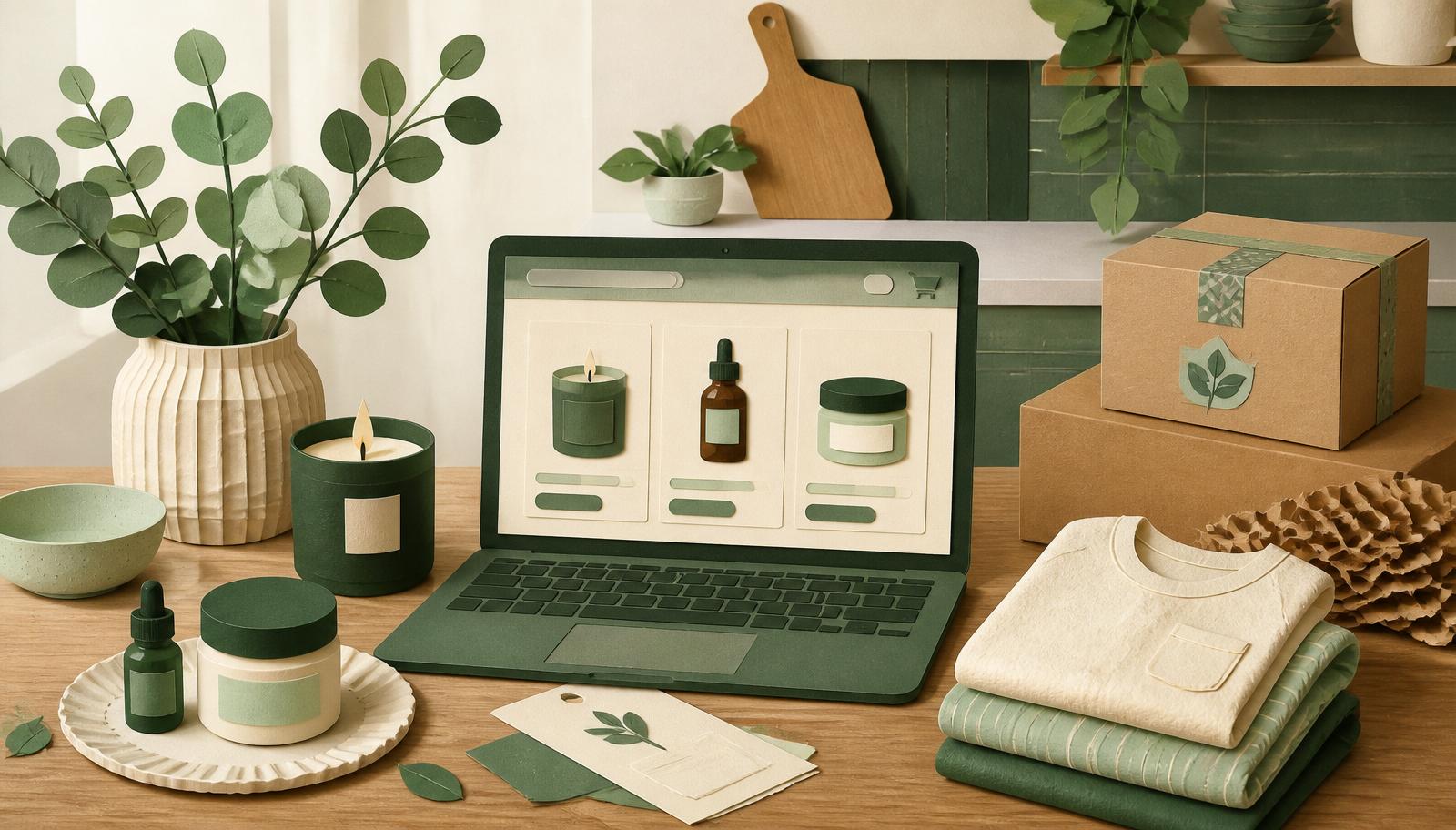
You poured everything into your online business. The late nights. The product photos. The Instagram captions. The packaging orders. The product descriptions written at the kitchen table after everyone else has gone to bed.
And when you write that your candles are "natural", your skincare is "eco-friendly", your kids' clothing is "sustainably made", or your homewares are "better for the planet", it probably feels honest — because you mean it honestly.
But here is the part many home business Australia sellers do not hear when they first decide to sell online Australia-wide: environmental claims are still advertising claims. In Australia, they need to be clear, accurate, and supported by evidence.1
The online audience is huge — and still growing
Australian online business is not a side channel anymore. NAB reported that online retail sales grew 15.4% year-on-year in May 2025 and estimated Australians spent $63.27 billion on online retail in the 12 months to May 2025.2 Australia Post later reported total online spend of $82.6 billion in 2025, up 14% year-on-year.3
That growth is exciting for small business ecommerce Australia — especially founders selling from home through Shopify, Etsy, Squarespace, Instagram, TikTok Shop, marketplaces, and pop-up markets that send customers back to a website.
It also means product descriptions matter. They are not just nice words on a page. They are often the claim a customer sees before buying.
Why sustainability language feels necessary
If you sell eco-friendly products Australia-wide, you already know customers ask about ingredients, packaging, fibres, materials, refills, local production, waste and shipping. Australia Post's ecommerce reporting notes that shoppers are shopping more frequently online and looking for value, while consumer-facing ecommerce commentary continues to point to sustainability as a factor in product choice.34
So it makes sense that small sellers reach for familiar words: natural, sustainable, conscious, low-waste, toxin-free, planet-friendly, plastic-free, biodegradable, compostable, ethical, clean, green.
The issue is not that those words are always wrong. The issue is that broad green words can mean different things to different customers. The ACCC's guidance is clear: businesses should avoid vague claims, explain important limitations, and have evidence to back up what they say.1
What "natural", "eco-friendly" and "sustainable" actually need to do
Under the Australian Consumer Law, businesses must not engage in conduct that is misleading or deceptive, and must not make false or misleading representations about goods or services.5 That applies whether you are a large retailer or an ACCC small business concern with a spare-room packing station.
In plain English, your claim needs to pass three tests:
- Is it specific? A customer can tell exactly what you mean — the fabric, ingredient, packaging, manufacturing step, certification, or comparison.
- Is it evidenced? You have something on file today: a supplier certificate, ingredients list, test result, packaging specification, audit, or documented methodology.
- Is it limited honestly? If the claim only applies to the jar, not the lid; the mailer, not the product; or a future goal, not today's product, that limitation appears next to the claim.
The safer version is usually not less warm. It is just more precise.
Three product descriptions that feel fine — but carry risk
1. The candle maker
"Our eco-friendly candles are made from natural wax and are better for your home and the planet."
Why it feels fine: the founder may genuinely use plant-based wax and avoid certain additives. Why it carries risk: "eco-friendly" and "better for the planet" are broad claims. "Natural" can also be unclear if the fragrance oil, dye, wick, jar, lid, label or packaging has different materials.
A clearer version might say: "Made with 100% soy wax and a cotton wick. Glass jar is reusable after cleaning. Fragrance oil is synthetic." That wording is less glossy, but it tells the customer what is actually true.
2. The skincare seller
"Clean, sustainable skincare made with non-toxic ingredients."
Why it feels fine: small skincare founders often care deeply about ingredients. Why it carries risk: "clean" and "non-toxic" can imply a safety or health comparison that may need substantiation. "Sustainable" is broad unless the claim says what is sustainable — ingredient sourcing, packaging, refill model, production process, or something else.
A clearer version might say: "Formulated without parabens or sulfates. Packaged in a 50ml glass jar with a polypropylene lid. Full ingredient list below." If there is a certification, name it and keep the certificate on file.
3. The kids' clothing brand
"Sustainably made children's clothing using eco-conscious materials."
Why it feels fine: the founder may choose organic cotton, small batches, or local sewing. Why it carries risk: customers may read "sustainably made" as a claim about the whole supply chain. If the evidence only covers the fabric, say that.
A clearer version might say: "Main fabric is GOTS-certified organic cotton. Garments are cut and sewn in Melbourne. Buttons are plastic." That kind of detail builds trust because it does not pretend the product is perfect.
Three simple fixes — before you publish
Fix 1: Swap big green words for exact facts
Instead of "eco-friendly packaging", write what the packaging is:
- "100% recycled cardboard mailer."
- "Home compostable satchel certified to AS 5810."
- "Glass bottle; plastic pump is not currently recyclable through kerbside."
Specific beats impressive. A customer can understand it, and you can prove it.
Fix 2: Keep a tiny evidence folder
You do not need a compliance department to start. Create one folder called "Product claim evidence" and save:
- supplier specifications and certificates,
- ingredient or material lists,
- packaging invoices or product sheets,
- certification licence details,
- screenshots of the claim as published, with the date.
If you cannot find evidence for a claim quickly, treat that as a sign to rewrite the claim until you can.
Fix 3: Add the limitation next to the claim
Do not hide the important detail in a footer, FAQ or shipping page. If the claim needs a condition, put it where the customer sees the claim.
For example: "Compostable mailer" becomes "Home compostable mailer — remove the paper label first." "Recyclable bottle" becomes "Bottle is kerbside recyclable; pump is not." "Plastic-free packaging" becomes "No plastic in the outer mailer; product contains a plastic safety seal."
A quick product description checklist
Before your next launch, run every environmental claim through these questions:
- What exact part of the product does the claim apply to?
- Would a regular customer understand the claim the same way you mean it?
- What evidence would you send if someone asked for proof tomorrow?
- Does the wording make the whole product sound greener than it is?
- Are any icons, leaves, badges or colours implying a certification you do not hold?
- Is the limitation beside the claim, not buried somewhere else?
- Has anything changed since you last wrote the product page?
The goal is not to scare you off talking about sustainability
The goal is to help you talk about it in a way that earns trust. Many small business owners are doing genuinely thoughtful things: choosing better materials, reducing plastic, making locally, ordering smaller batches, reusing packaging, or improving suppliers one step at a time.
You can still say those things. Just say them clearly. Say what you know. Say what the claim does and does not cover. Keep the proof. Update the page when the product changes.
If you want a fast starting point, run your homepage through our free scan. It takes under a minute and can help you spot the words most likely to need a second look.
Related reading: our guide to eco-friendly and sustainable product claims, the practical guide on how to avoid greenwashing in marketing, and why the ACCC is not only focused on large corporations.
Want a structured review of your own claims?
Sprout Check reviews the environmental claims on your website against the ACCC's December 2023 guidance, with suggested rewrites for anything that may attract scrutiny. From $249, delivered in 3–5 business days.
Get my assessment →Sources & references
- ACCC, Making environmental claims: A guide for business (12 December 2023). accc.gov.au.
- NAB Group Economics, NAB Online Retail Sales Index: May 2025 (1 July 2025). business.nab.com.au.
- Australia Post, Australia Post eCommerce Report 2026 — reporting 2025 online spend and shopping behaviour. auspost.com.au.
- WebAlive, 20 Key Ecommerce Statistics and Insights in Australia 2026, citing Australia Post and other ecommerce sources. webalive.com.au.
- Competition and Consumer Act 2010 (Cth), Schedule 2 (Australian Consumer Law), ss 18 and 29. legislation.gov.au.
Keep reading
More on ACCC greenwashing compliance
Consumer trust · 10 min
What counts as misleading and deceptive conduct in Australia? A plain-English guide
Enforcement · 9 min
"It'll be renewable one day": the ACCC case about a promise, not a product
Enforcement · 8 min
The ACCC is suing a major burger chain — and it's not about packaging
Or see all guides on the Sprout Check blog, browse real Australian greenwashing examples, or get a Sprout Check assessment of your own website.